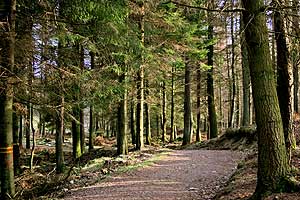
IN 2005-2006 FRIENDS OF CALLANDER MORAINE (FOCM) fought a long and arduous battle to save the north section of Callander Moraine from being destroyed by an aggregates company. In 2014, however, the south section will be lost: an old planning consent has been invoked and there is nothing we can do to stop it.
The battle for the north section
Consent for quarrying at Auchenlaich Farm in Callander was originally granted in 1991 by the then planning authority Stirling Council (Application reference: N/91/1125). In 1998 Stirling granted an extension (S/97/00485/DET). Under the terms of this extension quarrying was due to end on December 31st 2005.
In early 2005, the aggregates firm concerned applied to the new planning authority, Loch Lomond & The Trossachs National Park Authority (LLTNP) to extend its quarrying operation at Auchenlaich. A summary of the first version of planning application LT/2005/0127/DET/S, dated March 31st 2005, can be viewed on page 6 of the National Park Authority's Weekly Planning Schedule, 2005, Week 18.
The application was discussed at a meeting of the National Park Authority Planning and Development Control Committee at Kilmaronock Millennium Hall, Gartocharn on 19 September 2005, but the applicant hadn't mentioned the moraine and no one at the National Park was aware of it. The report provided to the committee may be downloaded from the National Park here.
At that meeting the Committee voted, as per the planning department's recommendation, to approve the application subject to conditions, including satisfactory conclusion of a Section 75 Agreement/bond. Minutes of the meeting are available here.
Developer vs geoconservationists
Having been alerted by Callander residents (FOCM's founders) to the scientific importance of Callander Moraine, the National Park Authority immediately sought expert advice. The Section 75 Agreement/bond had not been agreed and so planning consent had not yet been granted.
The developer withdrew the original version of LT/2005/0127/DET/S and submitted a revised one, also LT/2005/0127/DET/S, along with a report they had commissioned regarding the moraine, towards the end of 2005. This was discussed by the Planning Committee on 21st November 2005 and members were alerted to the existence and importance of Callander Moraine and requested additional reports. See the report here.
We, meanwhile, set about raising the alarm among the academic community about what was going on. Eminent geologists, archaeologists, and biologists all came on board to fight for the moraine.
At another meeting on 20th February the Planning Committee were presented with revised proposals from the developer following reports submitted by Scottish Natural Heritage (SNH) and the British Geological Survey (BGS). The President of the Quaternary Research Association (QRA) Professor John Lowe, who has a longstanding scientific interest in Callander Moraine, also provided an extremely detailed report explaining why the moraine should be protected from development.
On 20th February Callander Community Council voted against the revised proposal, but then rescinded its decision as a result of a telephone vote. CCC members had been advised by the National Park that they (CCC) had misunderstood a technical aspect of the developer's proposed restoration plan. Concerned that this second vote might be unconstitutional, we prompted them to hold another, extraordinary meeting in public on March 7th, at which we presented the case for preserving the moraine. Our efforts were in vain: they voted to support the quarrying application (minutes of that meeting here).
Fortunately, the National Park planners took on board the evidence that was now before them. March 20th 2006 was set as the date for a final meeting of the National Park Authority Planning and Development Control Committee to discuss the proposal. The planning officer's report to that meeting, along with Appendices, may be viewed here. In her report the planning officer recommended that the Committee refuse the application for reasons set out in Appendix 1 (chiefly, objections by residents, BGS, QRA], and also by SNH regarding the red squirrel population).
The developer fought on. Then, just as we were gearing up to fight them at the meeting on the 20th, much to everyone's surprise and delight they threw in the towel at the eleventh hour and withdrew their application.
Victory
On March 19th 2006 the Herald newspaper ran an article by Environment Editor Rob Edwards entitled "Victory for National Park as firm drops quarry plan on site of 'vital' ice age relic". Read the story here.
The British Geological Survey has also documented this triumph in Geodiversity of the Loch Lomond and The Trossachs National Park: Statement of Significance and Identification of Opportunities (Geology and Landscape (Northern Britain) Programme. Open File Report OR/07/036, page 15). In their report BGS recommends that, given the importance of landforms at Callander and elsewhere in the National Park area: "BGS should be contacted for advice about any planned removal of sand and gravel from glacial landforms within the park."
And the National Park itself ran an article about Callander Moraine by one of our members in the May 2006 edition of their magazine A' Phàirc, which can be accessed here.
2006 onwards
Although Callander Moraine was saved in 2006, developers are currently circling around Callander as a result of the National Park's Local Plan. A housing development has been built on the former Tannochbrae chalet park immediately to the west of the north section of the moraine. The old quarry site on the other side of this section has now been landscaped as part of the post-quarry conditions set by the Park, but, according to the Local Plan 2010-2015, the landowner intends to develop this site as a large-scale hotel and self-catering enterprise. A new Local Development Plan is currently being prepared by the National Park.
In 2014 we face the loss of the southern section of the moraine. Permission for quarrying was granted years ago before planning responsibility passed to the National Park and could not be revoked. The British Geological Survey intends to carry out a digital survey of the feature before it's destroyed, so at least there will be some record of it. Needless to say, FOCM and the people of Callander are distraught at the loss of this beautiful and very significant part of our landscape and history.
Yet more quarrying ahead
Aside from the Local Plan, more aggregates extraction (approved years ago) is due to start in Callander within a few years.
Mineral workings in Callander span two planning areas: the National Park and Stirling Council. Cambusbeg quarry and mineral processing plant towards Doune is physically linked to Auchenlaich via a purpose-built haulage road, but is in the Stirling Planning area. Stirling Council decisions relating to extensions of gravel and sand extraction operations at Cambusbeg include 05/00918/DET (12/2005-12/2007) and 04/00686/MIN (11/2004-11/2009).
Despite neighbours' objections, and concerns voiced by SNH with respect to the River Teith Special Area of Conservation (SAC) - more info about the SAC here - in 2008 Cambusbeg's operator was given the green light to extend their quarrying operations at Drumvaich until April 2013 (07/00629/MIN). As is customary, the National Park and Callander Community Council were both consulted, but neither of them objected.
Stirling Council's Public Access to Planning Applications and decisions is at:
http://planpub.stirling.gov.uk/publicaccess/default.aspx
The site in the spotlight now is Balvalachlan Farm off the A81 Mollands Road. Consent was granted by Stirling Council years ago for quarrying there, and it has not been possible for the National Park to instigate a review of that decision. Details are not available online but may be obtained through the National Park Authority in Balloch under whose control this site now falls. This is a large site, currently used for sheep grazing, and we gather that quarrying will commence as soon as the saplings screening the site from the road are tall enough.
Our concern in this instance is not geology-related - the site steers clear of major landforms. However, gravel will, we understand, be transported for processing via a conveyor over the River Teith. We can only hazard a guess at what the impact will be on the riparian environment and on the river's inhabitants.
For readers' future reference, this is what the National Park's Finalised Draft Local Plan says about mineral extraction (page 87):
"Policy MIN1. Proposals for Re-opening Old Mineral Sites and New Mineral Extraction
Support will be given to proposals to re-open old mineral sites where this would assist in replenishing the stock of traditional building materials in the Park, and where:
(a) there will be no adverse effect on the Park's special qualities, communities, traffic generation or flooding by virtue of the quarry or support infrastructure;
(b) the site will be subsequently restored and enhanced to provide benefits for the local community, biodiversity and the landscape; and
(c) there is provision to facilitate the recycling and re-use of waste resulting from mineral extraction and processing.
New mineral extraction including any proposed extension to existing facilities shall only be supported in exceptional circumstances, where it can be demonstrated conclusively that there is an overriding national interest and there is no reasonable alternative source outwith the Park, or that the material to be extracted is required to facilitate the enhancement and maintenance of the Park’s built environment. An Environmental Impact Assessment will normally be required for all new workings and a bond will be required in most instances for restoration and enhancement of ground conditions."
In truth, there will always be conflict between economic considerations and environmental ones. Quarrying is an important local industry, and aggregates for building and roads have to come from somewhere. In fairness, the company involved in Callander's quarries is conscientious when it comes to restoring exhausted sites.
But Callander's glacigenic landforms - the moraines, eskers and so on - are too important to be turned into concrete and macadam. We must protect them, and we fervently hope that the National Park will do so too. As all who are familiar with the statutory aims of Scotland's National Parks know, the Sandford Principle requires National Park Authorities to give the greatest weight to conserving and enhancing the natural and cultural heritage of the area. Let's hope that they do so.
ADDITIONAL INFORMATION
Other organisations who contributed to the effort to save Callander Moraine
Quaternary Research Association
Note: For detailed information on the geology of Callander Moraine see: Merrit, J.W. Coope, G.R. and Walker M.J.C. "The Torrie Late-Glacial Organic Site and Auchenlaich Pit, Callander" in The Quaternary of the Western Highland Boundary Field Guide (2003) London, QRA (pp. 126-133). The book can be ordered from QRA here.
Note: SNH's species action project on red squirrel conservation can be accessed here.
Callander & District Heritage Society
The National Park’s statutory obligations
The National Parks (Scotland) Act 2000 at the Office of Public Sector Information (OPSI)
Loch Lomond & the Trossachs National Park Authority publications:
State of the Park report 2005
State of the Park - Table of contents
Summary of the Park's history and guiding principles of Loch Lomond & the Trossachs National Park.
Report on the Park's geology
Report on the Park's biodiversity
Local Plan (2010-15)
Local Plan - Table of contents
Local Development Plan - in progress
The Local Development Plan that will replace the Local Plan- background info