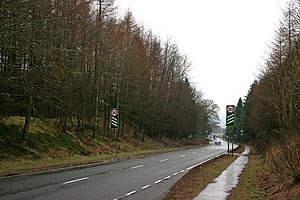
CALLANDER MORAINE, also known as Drumdhu or Auchenlaich Moraine, is situated at the entrance to Scotland's Loch Lomond & The Trossachs National Park where it straddles the A84 trunk road from Stirling to Callander (grid reference: NN 645 071).
At first glance it doesn't look terribly special - a very large, U-shaped bump that stretches from behind a mushroom farm to the south across Auchenlaich Farm to the north. Much of it is obscured from view by a conifer plantation. But, as is so often the way, appearances are deceptive: this bump is very special indeed because it is part of a family of landforms in and around Callander that mark the southern boundary of the last ice sheet to cover Scotland.
Around 13,000 years ago, things were looking pretty rosy in Western Scotland. The climate was mild and life thrived. Then something happened: 12,800 years ago the climate changed abruptly, plunging the region into arctic conditions that would persist for more than a thousand years. During that period, which is now termed the Loch Lomond Stadial, glaciers advanced across Western Scotland, scraping and scouring the rocks across which they travelled, transforming the very shape of the land. In some areas, life was obliterated; in others, the distribution of species changed dramatically.
When the ice finally melted around 11,500 years ago, sediments, rocks and organic debris that had been transported by the glaciers were released to create the landscape we see today. Although some local extinctions had occurred, plant and animal life did slowly return. Evidence of human activity in Callander stretches back more than 6,000 years. Notable archaeological sites include a Neolithic long barn (grid ref: NN 635 065) and Auchenlaich Cairn (grid ref: NN 649 073).
Since the glaciers retreated in Scotland the climate has remained comparatively steady, and only in the last 170 years - through the work of Swiss geomorphologist Louis Agassiz (1807-1873) and his successors - has it become apparent to human beings that particular types of depressions and bumps in the ground are, in fact, tell-tale signs of glaciation. When such signs are present in what are now temperate countries they are clear indicators of ancient climate change. Realising this, Agassiz introduced to science the notion of the 'Ice Age'.
Today's geomorphologists have at their disposal a range of sophisticated techniques that enable them to study landforms with much greater precision. They have discovered that Earth has experienced not one but many glacial periods that alternated with warmer, 'interglacial' eras such as the one we enjoy today.
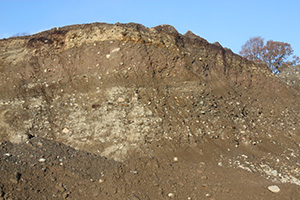
To scientists the beauty of Callander's cluster of landforms lies in the fact that they are so well preserved and that they clearly define where the Loch Lomond Readvance of ice terminated. Callander Moraine marks the extent of a glacier's journey down from the Trossachs via Loch Voil and Loch Lubnaig, and the material bulldozed by the glacier on its long journey is what forms the moraine. If we think in terms of the moraine being that glacier's final footprint then it is possible to appreciate, by looking at its vast sweep, just how enormous the glacier was. (If you still can't visualise it, visit Glaciers Online to see modern glaciers, and click here to see a comparatively recently-formed terminal moraine plus lateral moraines that enclose a lake in front of the receding Imja Glacier in Nepal.)
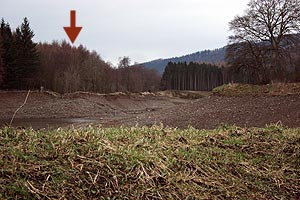
The southern, soon to be destroyed, section
Those wanting to visit or study the southern section in 2014 before it's quarried should contact the quarrying company direct to request permission to access the site. if you need their contact details.
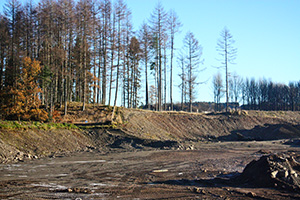
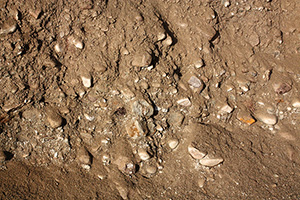
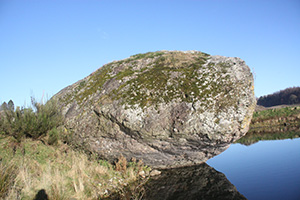
For those who cannot get there, local student Fraser Laming has very kindly given us permission to publish some of his photos of the moraine on the FOCM website. He's also provided a photo of a huge Old Red Sandstone glacial erratic that was deposited by the glacier as it retreated. This weighs over 1,000 tonnes and is thought to be one of the largest erratic boulders in Europe.
The bigger picture
We are now accustomed to the idea of a dynamic Earth and the reality of climate change. We also accept that our own activities - such as the burning of fossil fuels that release carbon dioxide - can accelerate and magnify natural climate fluctuations. The big questions are: how much environmental stress can the Earth tolerate before key climate-regulating systems, such as the North Atlantic Conveyor (the heat-circulating ocean currents that keep the UK's climate mild), fail? And how do individual tipping points in those systems interact leading to irreversible, catastrophic climate change? It is clear from observation of other planets, such as our neighbour Venus, that climate can and does reach a point of no return. Could the stress humans are putting on Earth's natural systems have the same effect? In short, is it possible that human activity could cause climate conditions to change so much that Earth can no longer support life?
These are grave questions indeed. In order to determine the answers, scientists must examine evidence of past climate change and work out both the causes and the consequences of major fluctuations. Glacial features, such as the suite in Callander that consists of the kettle holes at the Mollands and Tynaspirit 1, eskers at Tynaspirit 2 and the Roman Camp, and Callander Moraine at Auchenlaich, contain a wealth of clues. Carbon dating and the identification of ancient pollen and insect remains trapped within the features' sediments have helped researchers to reconstruct the chronology of the region's most recent prehistoric climate fluctuations. If we know what conditions particular organisms require now then we can infer through their presence or absence in ancient sediment layers what the climate was like when those sediments were laid down. Linking this information with other research findings - for instance, changes in ocean temperatures and atmospheric carbon dioxide levels that occurred at the same time - enables scientists to narrow down the probable causes of specific sudden warming or cooling events.
Earth heritage conservation: everybody’s responsibility
To work out how climate systems interact, evidence must be gathered from around the globe. Unfortunately, human activity has altered or obscured huge swathes of the Earth's surface and so high quality evidence can be hard to come by, especially in industrialised countries such as the UK. Callander's landforms, which have survived relatively unscathed, are therefore extremely precious. The Loch Lomond Readvance has been the subject of intensive research for more than 30 years and a great deal is now known about it. But what caused it, and whether there are any parallels with changes occurring in our climate systems today, are still unclear. It may take many decades to answer these questions, and so key sites, including those at Callander, must be preserved not only for current research purposes but also for the education of future Earth scientists and for those who will benefit from their work - in other words, every living organism on the planet.
Wherever we live on Earth we tend to think of our little patch of land as our own, to do with what we like. But now, as we face the practical challenges of climate change and the everyday reality of species extinctions, we can no longer think like this. The interrelatedness of scientific evidence and the interdependency of life forms mean that we must look at the bigger picture. If we have in our care an important natural landscape feature or environmental niche then we have a moral obligation to preserve it and allow it to contribute both to human understanding of our planet and to the survival of the species it supports. If we care at all about life - and we should do because, as far as we know, Earth is the only place in space that it exists - then we have a responsibility to contribute to its survival.
It is easy to get distracted by immediate wants and needs but, as Callander Moraine demonstrates, we need to think long-term - not just in terms of our own lives or those of our children but also of several hundred generations hence. What we do with our land now will affect the lives of all who follow us, and the effects are not always localised. It is easy to criticize those who are chopping down the Amazonian rain forest; but are we any better if we destroy crucial climate change evidence or the habitat of an endangered species?
Red squirrels
Callander Moraine is home to a small colony of red squirrels and their presence here has a particular poignancy. Although the decline of the native red squirrel in Scotland is not thought to be linked to climate change, these creatures are, nonetheless, emblematic of the fragility of life.
It is thought that only 121,000 red squirrels remain in this country. On February 27th 2006, Scotland's then Deputy Environment Minister Rhona Brankin launched a campaign to save them, warning that: 'Scotland's red squirrel population is likely to be extinct by the end of the century unless urgent action is taken to conserve the threatened native species.'
Our native squirrels are desperately vulnerable: they require very specific habitats; they face constant competition from grey squirrels who are more robust and more adaptable; and they have no resistance to the squirrel pox virus that can be carried by asymptomatic greys. If infected, red squirrels die within 15 days; symptoms are similar to myxomatosis in rabbits.
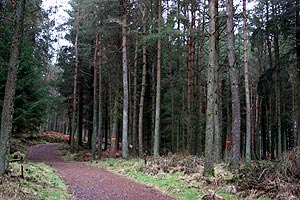
There are only a few red squirrels living on Callander Moraine but in this context every single one of them counts, as do the young that they rear each year. Look upwards when visiting the moraine and you will see their dreys. These woods are theirs and we have no right, morally or legally, to displace or harm them.
To view an Ordnance Survey map of Callander Moraine, click here and enter grid reference NN645071. The moraine lies at the centre of the map at Drumdhu Wood and Auchenlaich Farm.
To read about the launch of the Scottish Executive's action plan to save red squirrels please click here. And to read about the initiative's progress so far click here.